

Last Updated on September 2, 2025 by The Official Game Rules Team
Blackjack, also known as 21, is a classic casino card game that blends chance and strategy. This page provides a clear breakdown of the rules, guiding you through the goal of reaching 21 without busting, the various betting options, and the strategic decisions that define this popular game. With its simple premise and engaging gameplay, Blackjack offers a thrilling experience for both casual players and seasoned gamblers. Get ready to test your luck and skill against the dealer!

This post contains affiliate links. For more information, see our disclosures here.
How to Play Blackjack
Objective
- The objective of Blackjack, also known as Twenty-One, is to beat the dealer by getting a hand value closer to 21 than the dealer’s hand, without going over 21. Here’s a breakdown:
Setup
1. To play blackjack you need chips to bet with (or some other form of tokens that you can assign value to).
The standard denominations for casino chips are:
- white chips = $1
- red chips = $5
- green chips = $25
- black chips = $100
2. When you play blackjack at home, you should take turns being the dealer, to ensure fairness in the game (unless the player who is hosting the game specifically has stated that he or she wants to act as the house the entire game and the other players agree to this.)
3. You can switch dealer every hand, every five hands or whatever you decide. If you’re playing with a single deck of cards, the best idea is to re-shuffle after every hand. Of course, you don’t need a fancy blackjack table to play the game, but you will need at least one pack of cards and something to bet with – cash, chips or maybe matches.
Gameplay
1. Betting and winning
Each player at the blackjack table has a circle or box to place bets in. There will always be a minimum bet and a maximum bet for the table. The maximum bet is normally ten to twenty times the minimum bet, meaning that a table with a $5 minimum would have a $50 to $100 maximum. Each player decides how much to bet on a hand before the deal.
Each hand will result in one of the following events for the player:
- Lose – the player’s bet is taken by the dealer.
- Win – the player wins as much as he bet. If you bet $10, you win $10 from the dealer (plus you keep your original bet, of course.)
- Blackjack (natural) – the player wins 1.5 times the bet. With a bet of $10, you keep your $10 and win a further $15 from the dealer.
- Push – the hand is a draw. The player keeps his bet, neither winning nor losing money.
2. The Deal and the “Blackjack”
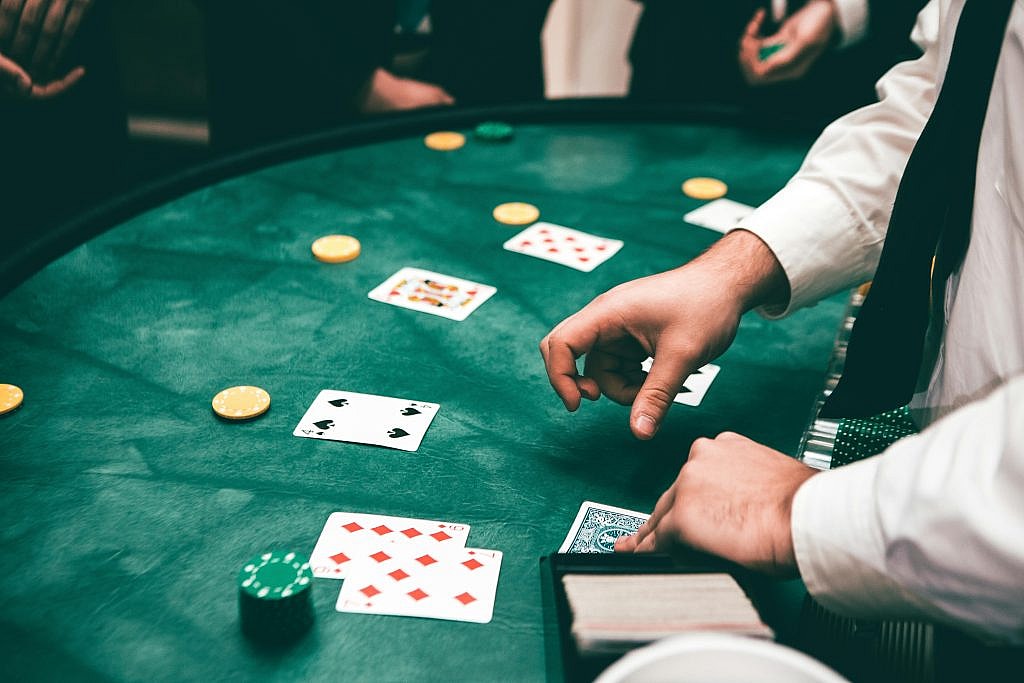
At the start of a blackjack game, the players and the dealer receive two cards each. The players’ cards are normally dealt face up, while the dealer has one face down (called the hole card) and one face up. The best possible blackjack hand is an opening deal of an ace with any ten-point card. This is called a “blackjack”, or a natural 21, and the player holding this automatically wins unless the dealer also has a blackjack. If a player and the dealer each have a blackjack, the result is a push for that player.
If the dealer has a blackjack, all players not holding a blackjack lose.
3. Players Turns
After the cards have been dealt, the game goes on with each player taking action – in clockwise order starting to dealer’s left. First, the player must declare if he wants to take advantage of the side rules (explained below). You can only use the side rules once, when it’s your turn to act after the deal.
Then the player can keep his hand as it is (stand) or take more cards from the deck (hit), one at a time, until either the player judges that the hand is strong enough to go up against the dealer’s hand and stands, or until it goes over 21, in which case the player immediately loses (busts).
In most places, players can take as many cards as they like, as long as they don’t bust, but some casinos have restrictions regarding this.
4. Dealers Turns
When all players have finished their actions, either decided to stand or busted, the dealer turns over his hidden hole card. If the dealer has a natural 21 (blackjack) with his two cards, he won’t take any more cards.
All players lose, except players who also have a blackjack, in which case it is a push – the bet is returned to the player.
If the dealer doesn’t have a natural, he hits (takes more cards) or stands depending on the value of the hand. Contrary to the player, though, the dealer’s action is completely dictated by the rules. The dealer must hit if the value of the hand is lower than 17, otherwise the dealer will stand.
Whether or not the dealer must hit on a soft 17 (a hand of 17 containing an ace being counted as 11) differs from casino to casino. There might even be blackjack tables with different rules within the same casino.
5. Showdown
If the dealer goes bust, all players who are left in the game win. Otherwise players with higher point totals than the dealer win, while players with lower totals than the dealer lose. For those with the same total as the dealer the result is a push: their stake is returned to them and they neither win nor lose.
Players with a blackjack win a bet plus a bonus amount, which is normally equal to half their original wager. A blackjack hand beats any other hand, also those with a total value of 21 but with more cards.
As described above, if the dealer has a blackjack, players with blackjack make a push, while all other players lose.
Winning the Game
- Blackjack: If your first two cards are an Ace and a 10-value card (10, Jack, Queen, King), this is an automatic win (Blackjack) and pays out at a higher rate than a regular win (usually 3:2).
- Higher Value than Dealer: If your hand total is closer to 21 than the dealer’s hand total without going bust, you win. Winnings are typically paid out at 1:1.
- Dealer Busts: If the dealer’s hand total goes over 21 (busts), you win regardless of your hand value.
- Push: If your hand total equals the dealer’s hand total, it’s a tie (push) and your bet is returned without any winnings or losses.
- Lower Value than Dealer: If the dealer’s hand total is closer to 21 than yours without busting, you lose your bet.
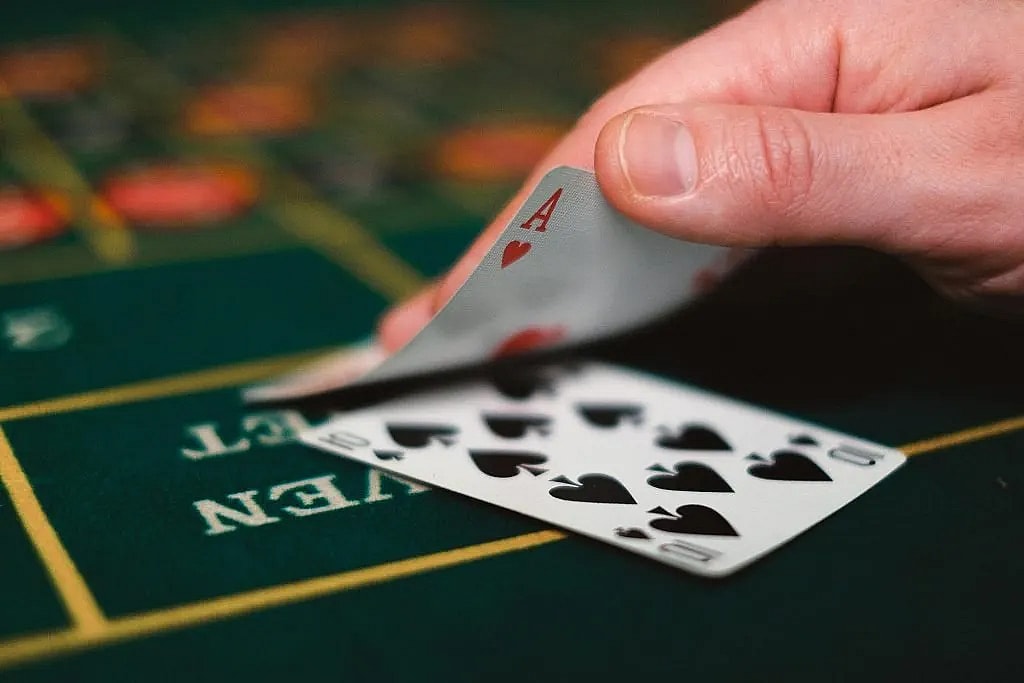
Example of a winning Blackjack hand
Notes/Variations
Above, the basic rules of blackjack are described. In addition, numerous side rules allow for more intricate betting strategies. These side rules can only be used immediately after the deal, before you take any more cards. You cannot, for example, take a third card and then decide to double down.
The most widely practiced options are explained below:
Insurance
- When the dealer’s face-up card is an ace, each player gets the chance to bet on whether the dealer has a blackjack or not. This is done before any other player actions.
- The insurance wager equals your original bet and is used to cancel out the likely loss of this bet. A winning insurance bet will be paid at odds of 2:1, and since you lose your original bet, you’ll break even on the hand. Strategy guides tend to advice against taking insurance.
Surrender
- If you have a bad hand compared to the dealer’s hand (judging from what you can see of it,) you can give up the hand and reclaim half your bet. The casino keeps the other half uncontested. You need a really bad hand match-up for a surrender to be profitable, such as 16 vs the dealer showing a 10.
- At some casinos, surrenders will not be allowed if the dealer has a blackjack (which he then checks for immediately after the deal). If the dealer has a blackjack, no surrenders will be granted and you’ll lose the entire bet – unless you also have a blackjack, in which case it’s a push. This side rule variation is called late surrender.
Splitting
- When you get two starting cards of the same face value, you have the option to split the hand in two. You place another bet of the same size as the original bet and play on with two hands. (Note that it is legal to split 10-point cards even if they do not form a pair – for example you could split a jack and a king.)
- When you’ve decided to split a hand, the dealer immediately deals a second card to each hand. Now, if you’re dealt yet another pair, some casinos allow you to split the hand again, while others don’t.
- When you’re done splitting, each of your hands will be treated separately, meaning that you will take cards to your first hand until you stand or bust, and then carry on with the next hand.
- If you split aces, you are dealt a second card to each hand as usual, but you are not allowed to take any further cards (unless you are dealt another ace and split again). All hands resulting from splitting aces remain as two-card hands.
- If the second card dealt to a split ace is a 10-point card you do not receive the blackjack bonus for this hand. It does however win against an ordinary 21 made of more than two cards. If the dealer also has a blackjack the result for this hand is a push as usual. In many places the same rule (no blackjack bonus) is played if an ace is dealt as the second card to a 10-point card after splitting.
Doubling Down
- If you’re fairly sure that your hand will beat the dealer’s, you can double your original bet. You’re sometimes allowed to double down for any amount up to the original bet amount. In most casinos you may double down on any hand, but some casinos require an opening hand worth 11, 10 or 9.
When you’ve chosen to double down, you’ll only get one more card from the dealer.

Blackjack FAQ
You win by either having a higher total than the dealer without exceeding 21 or if the dealer busts (goes over 21).
Players are dealt two cards and can choose to hit (take another card) or stand (keep current hand). Face cards count as 10, Aces as 1 or 11, and other cards at face value.
A Blackjack is when your first two cards total exactly 21 (an Ace and a 10-value card). It usually pays 3:2.
If your first two cards are the same value, you can split them into two separate hands and play each individually.
Doubling down lets you double your original bet after receiving your first two cards, then take only one additional card.
Yes! Basic Blackjack strategy involves knowing when to hit, stand, split, or double down based on your hand and the dealer’s visible card.
Insurance is a side bet offered when the dealer shows an Ace. It pays 2:1 if the dealer has Blackjack but is generally not recommended for long-term play.
Blackjack can be played with one to eight decks, depending on the casino or house rules.
Conclusion
Remember! You don’t compete against other players, only the dealer. Basic strategy charts are available online or in casinos to help you decide whether to hit or stand based on your hand value and the dealer’s face-up card. Blackjack is a game of chance with some elements of strategy so don’t get discouraged if you don’t win at first!
Browse Related Games!
 Official Casting Shadows Rules
 Official Twenty-Nine Rules
Official Canadian Salad Rules
Official Twenty-Nine Rules
Official Canadian Salad Rules
 Official Coup Rules
 Official Sergeant Major Rules
 Official Command of Nature Rules
Official Panguingue (Pan) Rules
Official Scat (31) Rules
Official Command of Nature Rules
Official Panguingue (Pan) Rules
Official Scat (31) Rules
 Official Tell Me Without Telling Me Rules
 Official Paco Rules
 Official Canasta Rules
 Official The Fox in The Forest Rules